ABOUT
BCRC-SEA’S
An overview of BCRC-SEA’s institutional mandate, legal status, and core functions in supporting environmentally sound management of hazardous waste in Southeast Asia.
LEGAL STATUS
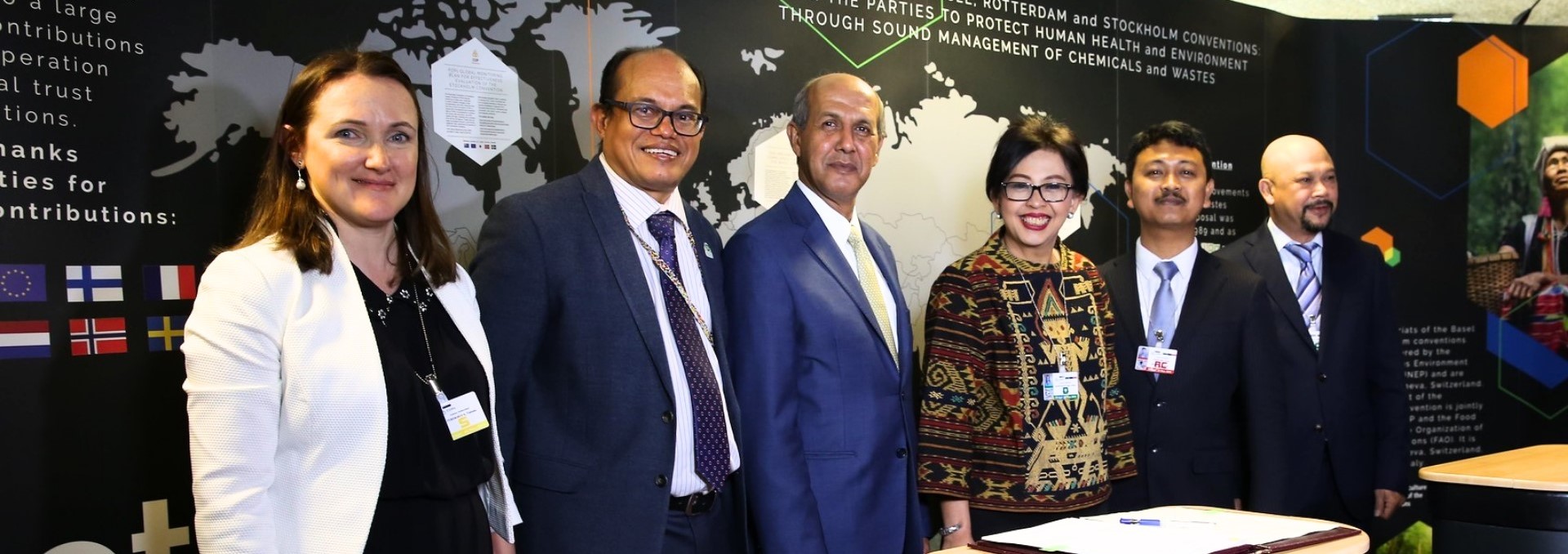
The Basel Convention on the Control of Transboundary Movements of Hazardous Waste and their Disposal in Article 14 requires the establishment of Regional Centers for Training and Technology Transfer (BCRC). Furthermore, the Decision III/19 at Conference of the Parties (COP) III in 1995 selected Indonesia to host one of BCRCs. The Government of the Republic of Indonesia then signed the Framework Agreement on BCRC for Southeast Asia (BCRC-SEA) with the Secretariat of the Basel Convention (SBC) on 29 October 2004 in Geneva, Switzerland. The Framework Agreement was later endorsed by Presidential Regulation No. 60/2005 on 12 October 2005 and it has since been amended twice for extension until 2029.
At the sixth meeting of the Conference of the Parties of the Stockholm Convention (COP-6) in 2013, BCRC-SEA was endorsed as one of the Stockholm Convention Regional Centre (SCRC) and the mandate has been extended until 2023 by decision of COP-9 of the Stockholm Convention in 2019.
BCRC-SEA & SCRC Indonesia is supported by 10 countries: Brunei Darussalam, Cambodia, Lao PDR, Malaysia, Myanmar, Indonesia, Singapore, Philippines, Thailand and Vietnam. Framework Agreement between the Government of Indonesia and the Secretariat of the Basel Convention was extended until 2029
Meet Our Team

Mr. Anton Purnomo, S.T., M.Sc., Ph.D
Director
Mr. Dadan Wardhana Hasanuddin
Senior Officer
Ms. Cynthia Indriani, S.T.
Executive Secretary
Ms. Fitriyana Lafifa, S.T.
Admin & Financial Officer
Mr. R.R. Bramansyah, S.Sos, M.Si.
Technical Officer 1
Ms. Tri Anis Sholihah Nurjanah S.T.
Technical Officer 2
Mr. Ricky Herjunata, S.T.
Technical Officer 3
Ms. Sita Anggraeni, S.Sos
Admin Officer 1
Ms. Syahla Umama
IT & Admin Officer 2BCRC-SEA’S MISSION OBJECTIVES
- Develop and conduct training programs, workshops, seminars and associated projects in the field of environmentally sound management of hazardous wastes, transfer of environmentally sound technology, and minimization of the generation of hazardous wastes, with specific emphasis on training the trainers and promoting ratification and implementation of the Basel Convention and its instruments.
- Organize meetings, symposiums and field missions useful for carrying out these objectives in the region.
- Promote public awareness on hazardous waste management and related environmental issues.
- Identify, develop and strengthen mechanisms for the transfer of environmentally sound technologies in the field of hazardous waste management and waste minimization in the region.
- Gather, assess and disseminate information in the field of hazardous wastes and other wastes to Parties of the region and to the Secretariat.
- Collect information on new or proven environmentally sound technologies and know-how relating to hazardous waste management and minimization, and disseminate such information to Parties of the region at their request.
- Encourage best approaches, practices and methodologies for environmentally sound management and waste minimization, including through case studies and pilot projects.
- Establish and maintain regular exchange of information relevant to the provisions of the Basel Convention and promote networking at national and regional levels.
- Cooperate with the United Nations and its bodies, particularly UNEP and Specialized Agencies, as well as other relevant intergovernmental organizations, industry stakeholders, and non-governmental organizations.
- Coordinate activities, develop and implement joint projects related to the Basel Convention, and promote synergies with other multilateral environmental agreements where appropriate.
- Provide assistance and advice to Parties and non-Parties of the region upon request on matters relating to environmentally sound management and minimization of hazardous wastes and implementation of the Basel Convention.
- Cooperate in mobilizing human, financial and material resources to meet urgent needs of Parties facing incidents or accidents that cannot be addressed with their own means.
- Perform any other functions assigned by relevant decisions of the Conference of the Parties of the Basel Convention or by Parties of the region, consistent with such decisions.
- Develop, within the general financial strategy approved by the Parties, the Centre’s own strategy for long-term financial sustainability.
CORE FUNCTIONS

Training

Technology Transfer

Information

Consulting